
Most teams say they value learning. Then you look at how the week actually runs and learning is the first thing that gets cut. The conference budget is frozen, the “learning Friday” gets eaten by the release, the new tester is told to “just pick it up as you go,” and the one person who understands the payment integration is too busy to explain it to anyone. The team still ships, so it feels fine. But quality is quietly paying the bill, because a team that does not learn cannot see what it does not already know.
So here is the case I want to make, and it is a practical one: learning culture is a quality strategy, not a perk you get to after the real quality work. What your team understands is upstream of almost every quality outcome you care about. Here is the uncomfortable version of that claim: most of your worst escaped defects were not missed because someone did not test hard enough. They were missed because nobody on the team understood the part of the system where the bug lived. You cannot test your way out of a knowledge gap, which is exactly why learning is testing you do in advance. Most of this is written for the leads and managers who can build that culture. If you are a tester with no authority over the budget or the calendar, the second half is yours.
Why learning is a quality lever, not a nice-to-have
Quality problems are rarely a shortage of effort. Most of the time they are a shortage of understanding, and the path from one to the other is short.
- Understanding comes faster. People who learn deeply pick up the technology quicker, so they get to the real questions sooner.
- More risk gets spotted. You cannot test for a failure mode you have never heard of. The more a tester understands, the more they can see coming.
- Silos shrink. When knowledge is shared instead of trapped in one person’s head, the bus factor stops being scary.
- Testers grow up. They move from a junior view of the product to a senior one, from “does this button work?” to “what does this change put at risk?”
That last shift is the one I care about most. A junior tester checks the thing in front of them. A senior tester sees the thing in front of them and the three systems it quietly touches. The distance between those two testers is rarely talent. It is accumulated understanding, and you can invest in that on purpose.
A team that does not learn cannot see what it does not already know. That blind spot is where your worst defects live.
This is why I never treat learning as something that competes with delivery. Picture a payments feature on Vendly, the made-up app I use for examples. A tester who spends two afternoons actually understanding how refunds, chargebacks, and partial captures interact is the one who later catches that a “small” discount change would double-refund a slice of customers. Those two afternoons were the cheapest testing the team did all quarter.
What a learning culture actually provides
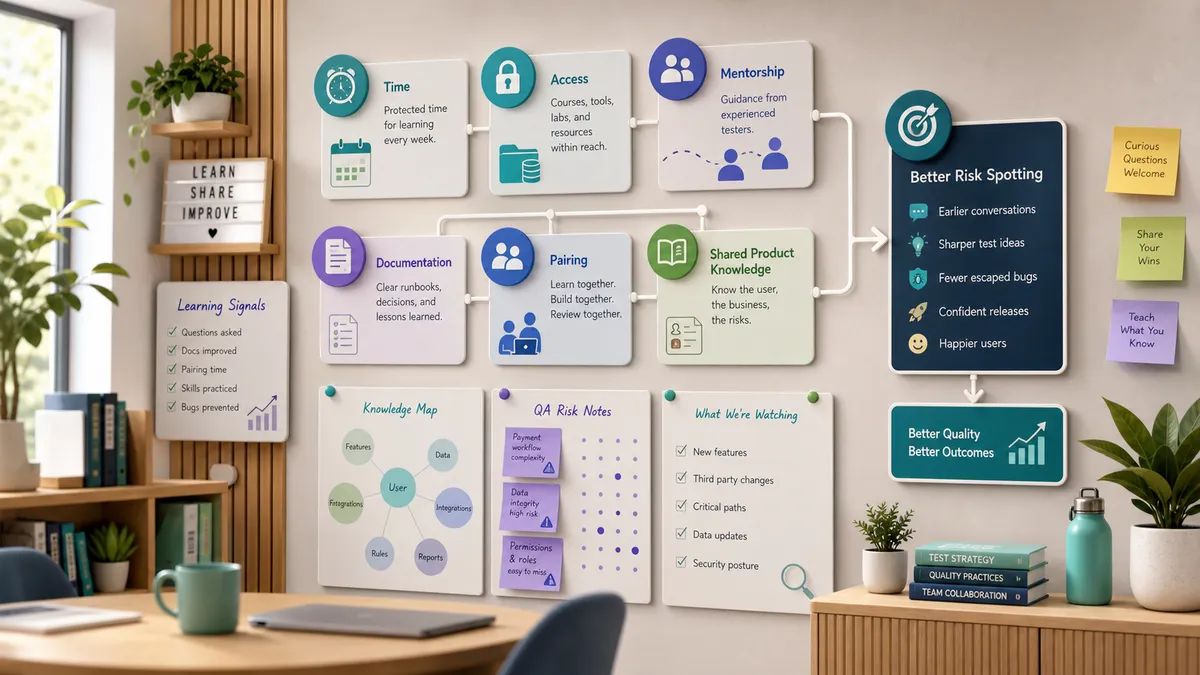
“We support learning” means nothing until it shows up in time, money, and access. If you lead a team, here is what a real learning culture puts on the table. Treat it as an audit: for each row, can you point to where it actually exists?
| What you provide | What it looks like in practice | What it buys you |
|---|---|---|
| Time | Protected hours that survive a busy sprint, not “learn on your own time” | People go deep instead of skimming |
| Budget | Courses, books, conferences, certifications without a fight | Skills the team does not currently have |
| Access | Real code, real environments, the product spec, the people who built it | Testers who understand the system, not just the screen |
| Mentorship | A named person to ask, pairing, code and test review as teaching | Juniors become seniors instead of plateauing |
| Documentation | Written-down decisions, runbooks, “why we did it this way” | Knowledge survives people leaving |
| Different modes | Reading, video, pairing, building a spike, teaching others | Everyone learns, not just the people who learn the way you do |
That last row is the one teams forget. People learn differently. Some read the docs, some need to watch someone do it, some only really get it once they have to explain it to someone else. A learning culture that only offers one mode quietly excludes most of the team.
A learning culture audit you can run this week
If you want something concrete to do, score your team out of these. Honest answers only, and each row names the condition that means it is genuinely true, not just aspired to.
- Onboarding path. Done when: a new tester has a written first-month learning path, not just a backlog of tickets.
- Protected time. Done when: learning time sits on the calendar and survives a busy release week.
- Real access. Done when: every tester can reach real code, real environments, and the product spec without asking permission each time.
- A person to ask. Done when: each tester has a named person they can ask without feeling like a burden.
- Knowledge written down. Done when: the last hard problem the team solved has its lesson captured somewhere findable.
- Learning out loud. Done when: people teach each other in the open, and that is treated as real work, not a distraction.
- Budget reality. Done when: the budget has a learning line, not just tooling and headcount.
Any box you cannot tick is not a soft gap. It is a place where risk is going to slip through because someone did not understand something they were never given the chance to learn.
If you are a tester with no authority
You may not control the budget, but you control more than you think. Learning culture is partly built from the bottom. Here is what you can run this week, on your own:
- Learn out loud. When you figure something out, write it up where the team can see it. You become the person who reduces silos, and that reputation compounds.
- Advocate for yourself. Ask for the project that scares you a little, the one that would force you to learn the part of the system you avoid. Do not wait to be handed it.
- Ask for specific feedback. “How am I doing?” gets you a shrug. “What is one thing I could do better on my bug reports?” gets you something you can act on this week.
- Make a simple plan. One line: where do I want to grow next, and what is the next skill that gets me there. Revisit it monthly.
And use the communities that are practical about testing, not just loud about trends. I came up teaching, running bootcamps for people moving into tech, plenty of them without a degree, and the ones who grew fastest were not the ones with the most resources. They were the ones who kept showing up to learn. The places I send people to are Ministry of Testing and Test Automation University, because they make real testing knowledge free and accessible. In Jamaica we say every mickle makes a muckle, and small, consistent learning genuinely adds up over a career.
Where this connects
Learning culture does not replace a quality strategy; it makes one possible. A team that understands its product can do risk-based quality work instead of guessing at it. A team that keeps learning is the one that can choose automation with judgment instead of automating whatever is easy. And if you are still early, the become a QA engineer path is a structured place to start building the toolkit this whole argument depends on.
The one thing to do next
Pick a single row from the audit table where your team is weakest, and fix it this month. Not all of it. One row. Protect two hours of learning time, or write down the one piece of knowledge that lives in only one person’s head, or give a tester access to the environment they have been asking for.
Quality is not only what you test. It is what your team is capable of seeing. Invest in the seeing, and better testing follows.

Written by
Julia Pottinger
Hi, I'm Julia. I've been in QA for over a decade. I spend my days testing software and my own time building apps and games, and I write here to share what I learn, the practical, honest lessons you can actually use.


Comments 0
Share your thoughts, ask questions, or add to the conversation.