
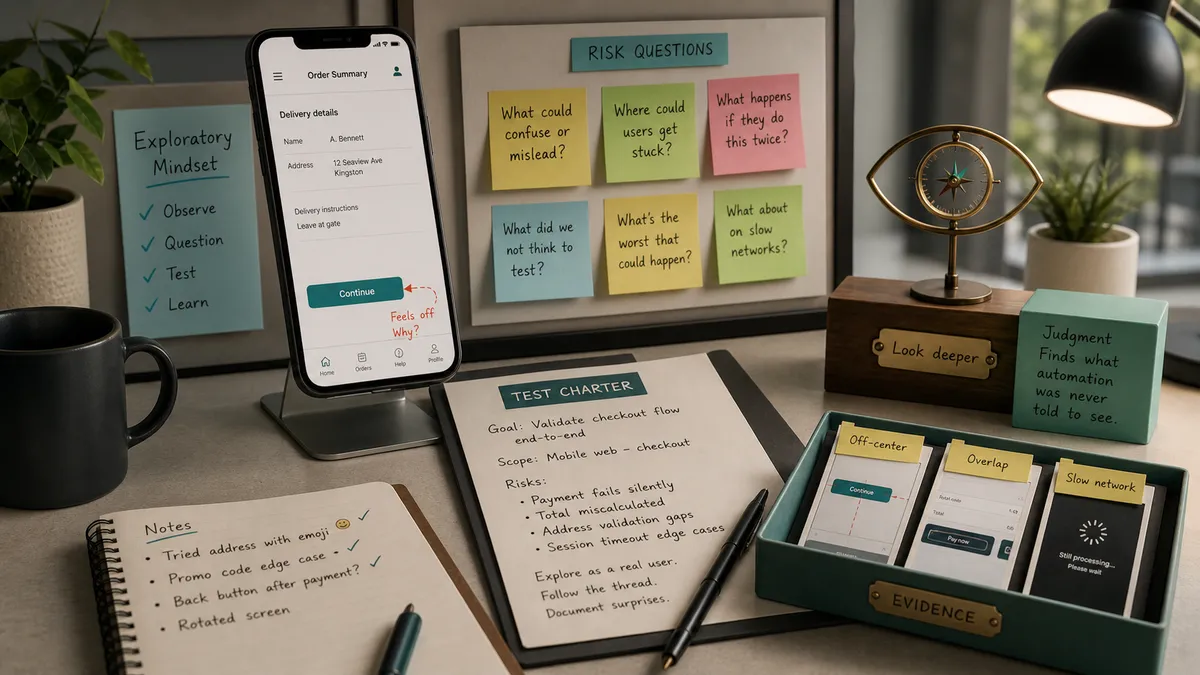
On a large retail platform I tested, a “spend more, save more” promotion went out with every automated check green. The discount applied, the cart total came back, the API returned what it should. All passing. What no check was pointed at was the little progress line, the “spend X more to reach the next tier” number. At the exact cart amount where you cross from one tier into the next, that number was wrong. The discount itself was fine, so every check that asked “did a discount apply” passed. A person looking at the boundary on purpose is the reason it never shipped.
That is the thing green does not tell you. A passing suite tells you the checks you thought to write still pass. It does not tell you the product is correct, because it only measures the cases someone already imagined. The gap between “the checks I wrote” and “everything that could be wrong” is exactly where a human tester lives.
So every few years, when someone announces that automation, or now AI, will end manual testing, I think about that tier boundary. The tools keep getting genuinely better. The teams that lean on them entirely keep shipping confident-looking software with holes in it. Manual testing is not going away, and AI makes that more true, not less. But it is worth being honest about what the work actually is, because the caricature of a person aimlessly clicking around deserves to die. The real thing does not.
What manual testing actually is
Manual testing is not “the testing we have not automated yet.” At its best it is exploratory testing: learning the product and testing it at the same time, steered by a question and recorded as evidence. It is understanding the business logic before anyone writes a single automated check. It is noticing the thing that is technically correct and still wrong for the person using it.
Automation is very good at one job: repeating a check you already understand, quickly and consistently, across many builds. I have built and taught plenty of it, so this is not an anti-automation argument.
But sit with the word already. Someone has to understand the product first. Someone has to decide what is worth checking, what “correct” even means here, and how this thing can break. On that promotion, someone had to think to look at the tier boundary at all. That someone is doing manual, human testing, whether or not anyone puts that name on it.
Automation checks what you already know. Manual testing is how you find out what you didn’t.
Take one flow everyone knows, a checkout, and look at where the two kinds of testing actually land. Automation nails the things you can state exactly. A human is left with everything that needs judgment, and that is the half where the costly bugs hide.
Where the human is non-negotiable
The case for keeping a human here has nothing to do with nostalgia. There are specific things AI and automation are still bad at, and a good tester knows exactly where those lines fall.
- Seeing that the UI is wrong. A script can confirm the checkout button exists and is clickable. It cannot feel that the button has slipped below the fold on a small phone, that the spacing is off, or that the contrast makes the price unreadable. On Vendly, a made-up app I use for examples, automation can verify the cart total to the cent while a real human is the only one who notices you have to scroll past the fold to find the Pay button. This gets dramatically harder on mobile and in games, where you are dealing with real devices, many screen sizes, and visual judgment a script does not have.
- Following a real end-to-end user flow. Not whether each step passes, but whether the whole journey makes sense for an actual impatient person on a bad connection. That unified, does-this-hang-together judgment is human.
- Exploratory testing. Going off the script on purpose to find the bug nobody wrote a test for. It is skilled, structured work, not random clicking, and it gets its own treatment in exploratory and session-based testing.
- Finding the real risks and the gaps. AI can generate test cases for the scenarios it has seen a thousand times. It cannot reliably tell you what your specific product, your specific users, and your specific business are most exposed to. That risk read is the most valuable thing a tester does, and it is human.
- The business call. Whether something is good enough to ship is a judgment about users, risk, and timing. A tool can give you evidence. It cannot make that decision for you.
The tier-boundary bug at the top of this piece is one flavour of this, and it is the one I keep running into: the screen looks fine and the data underneath is wrong. The button works, the toast appears, the page refreshes, and then you open the actual record or the API response and the product did not do what it claimed. Nothing on the surface looks broken, so nothing on the surface fails a check. You only catch it by knowing what the number is supposed to be and going to look.
If you want the longer version of how to combine structural checks, screenshots, model review, real-device testing, and human judgement, I went deep on it in AI visual testing. The short version: AI is uneven. Hand it the data, the contracts, and the repetitive analysis it is genuinely good at, and keep the human for visual sense, user flow, risk, and the decision on what is good enough.
The same point, for three different readers
This argument lands differently depending on where you sit, so here is the version for each.
If you are new and worried AI will take the job before you get one: breathe. The skill that makes you valuable is not the mechanical part:
running a test script
understanding a product, spotting what is risky, and explaining what you found
That is exactly the part AI is worst at, and it is learnable. Build it first. Your manual and exploratory testing skills are the foundation everything else, including your automation, will stand on. I am not arguing the wider point here; the future of QA is stronger testers, not fewer, and manual testing is where that strength starts.
If you are an experienced tester in an automation-heavy org: do not let the suite lull the team to sleep. A wall of green is comforting, and it only ever proves that the checks someone already thought to write still pass. It says nothing about the risks nobody wrote a check for. Keep running exploratory charters every release. Keep asking what changed and what new risk it introduced. The automation handles the knowns so you have time for the unknowns, which is where the scary bugs live.
If you manage a team and you are tempted to cut manual testing to save money: understand what you are actually cutting. You are not removing slow, low-value clicking. You are removing the team’s ability to notice the problems no test was written for, and to understand the product well enough to automate it sensibly in the first place. The savings show up this quarter. The escaped defects, the blind spots, and the brittle automation built on shallow understanding show up next quarter, and they cost more.
A simple way to split the work
You do not have to choose between automation and manual testing. You have to put each where it is strong. When you are deciding what to do with a given check, this is roughly how I think about it.
| Lean automated | Lean manual / exploratory |
|---|---|
| Stable behaviour that rarely changes | Anything still changing shape every sprint |
| Important checks you repeat every release | A brand-new feature you do not fully understand yet |
| Fast feedback on known risks (smoke, regression) | Hunting for unknown risks and gaps |
| Exact, machine-checkable outcomes (totals, status codes) | Visual correctness, layout, “does this feel right” |
| Things a human would find mind-numbing to repeat | Whole user journeys and judgment calls |
Decide the risk first, then pick the tool. Automating a check you do not understand just moves the misunderstanding into code, where it is harder to see.
Where this connects
If you want to get good at the part that is not going away, exploratory and session-based testing is the craft to build, and is that green checkmark real? is the companion to this piece on why a passing suite is not the same as a working product.
The one thing to remember
Manual testing is the understanding and the judgment that the rest of QA stands on. Automation repeats the cases you already thought of. Someone still has to think of them, notice the tier number no check was watching, and decide the product is good enough to ship. Tools will keep getting better, and you should use the good ones. Just remember that a wall of green measures your imagination, not your product, and closing that gap is human work.

Written by
Julia Pottinger
Hi, I'm Julia. I've been in QA for over a decade. I spend my days testing software and my own time building apps and games, and I write here to share what I learn, the practical, honest lessons you can actually use.

Comments 0
Share your thoughts, ask questions, or add to the conversation.